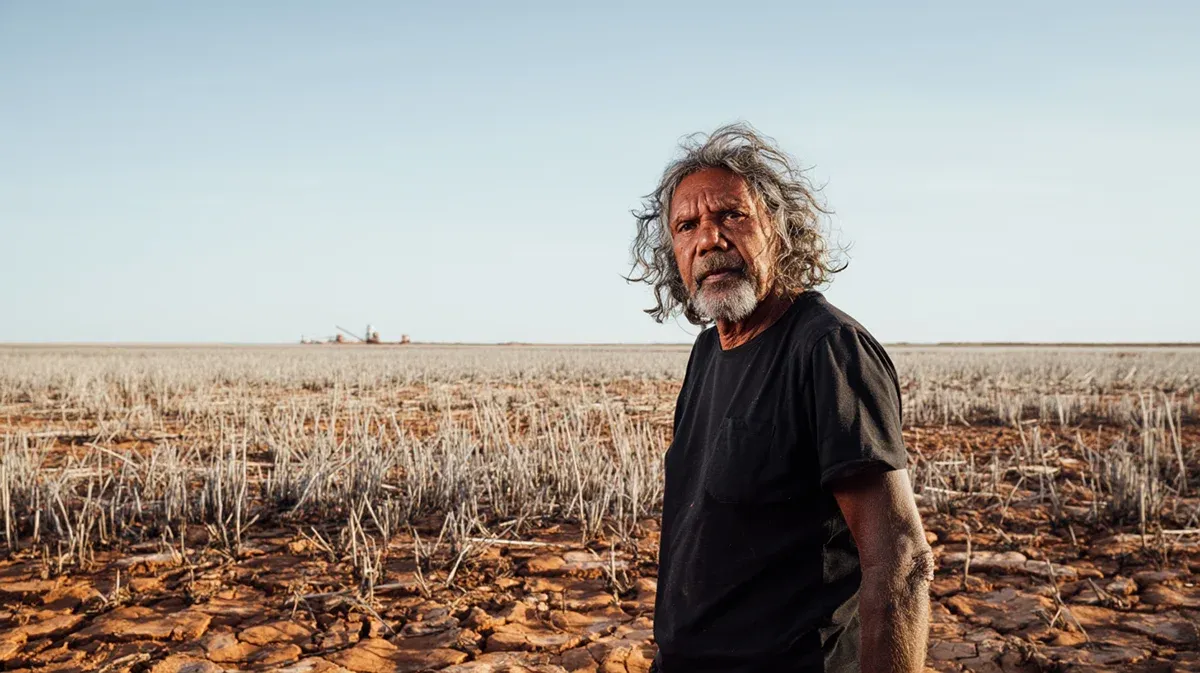
Southern Africa already showed the pattern. Drought pushed millions in Zambia, Zimbabwe, and Malawi deeper into food insecurity even though these countries contributed almost nothing to the heating that made the shock more dangerous. At the same time, the companies that sit above the food chain were positioned to gain from tighter markets and higher prices. Farmers lose harvests. Households lose food security. Traders and processors gain pricing power. Scarcity does not only destroy. It redistributes upward.
“Scarcity does not only destroy. It redistributes upward.”
That is the part polite climate language keeps hiding. El Niño is not just a climate signal. In an overheated world, it becomes a sorting mechanism. It decides who runs out of water, who loses crops, who gets displaced, and who gets to sell emergency supply, credit, transport, and insurance into the wreckage. The weather does not do that by itself. The market structure does.
The same pattern shows up in water. When rainfall fails and public systems buckle, private operators step in, not as neutral rescuers but as companies selling access under scarcity. Suez and Veolia did not build their global business by preventing this kind of breakdown. They built it by operating where public systems weaken and emergency provision becomes profitable. Climate stress turns basic survival into a revenue line.
Disaster response follows the same logic. Every drought, flood, or crop collapse creates new business for logistics contractors, consultants, insurers, infrastructure firms, and commodity intermediaries. The worse the breakdown, the more money moves through crisis management. That does not mean every actor wants catastrophe. It means catastrophe has already been wired into profitable channels. Too many powerful institutions now make money from response, recovery, emergency procurement, and distressed assets, while prevention remains starved of money and political urgency.
“Climate stress turns basic survival into a revenue line.”
That is why adaptation stays weak. Governments still find room for fossil subsidies, military spending, and emergency bailouts, but not for the irrigation systems, public grain reserves, water infrastructure, and heat protection that would reduce the damage before it lands. This is not a technical oversight. It is a political choice about what gets funded before crisis and who gets paid after it.
Finance understands this perfectly. Climate-risk firms do not exist to stop displacement or crop loss. They exist to tell investors which regions are becoming harder to inhabit, which assets will be repriced, and where new returns can be extracted from breakdown. Insurance works the same way. Protection gets thinner where risk rises and people are poorer, while capital withdraws upward into safer zones and more insurable clients. Those at the edge lose cover first.
This is why the usual language about “vulnerability” is too soft. Vulnerability sounds like misfortune. What is happening is harsher than that. Entire populations are being positioned as shock absorbers for a planetary crisis they did little to create, while firms and investors further up the chain prepare to monetize scarcity, displacement, and emergency dependence. The suffering is local. The gains are organized elsewhere.
So when El Niño returns, the question will not just be how hot, how dry, or how destructive it becomes. The question will be who gets broken by it and who gets paid through it. The countries likely to suffer most did the least to overheat the atmosphere. The corporations and financial actors best placed to profit are largely based in the countries most responsible for building the fossil economy that destabilized the climate in the first place.
El Niño 2026 will not be a natural disaster that happens to have economic effects. It will be an extraction event moving through weather. The heat is not natural. The profits are not accidental. And the line between who suffers and who benefits is not random. It is the system working as designed.
“El Niño 2026 will not be a natural disaster that happens to have economic effects. It will be an extraction event moving through weather.”
- VG — Frykter et heftig værår: – Enda mer ekstremvær
- World Meteorological Organization (WMO) — Earth’s climate swings increasingly out of balance
- World Meteorological Organization (WMO) — Global Seasonal Climate Update for April–May–June 2026
- NOAA Climate Prediction Center — ENSO Diagnostic Discussion, 12 March 2026
- World Meteorological Organization (WMO) — WMO report documents spiralling weather and climate impacts
- World Weather Attribution — When Risks Become Reality: Extreme Weather in 2024
- World Food Programme (WFP) — Southern Africa Drought
- United Nations Office for the Coordination of Humanitarian Affairs (OCHA) — The Humanitarian Impacts of El Niño in Southern Africa
- Associated Press (AP) — reporting on Arctic sea ice reaching its lowest winter maximum on record
- WMO for the core point that the climate system is already more unstable and out of balance than before
- NOAA for the probability that El Niño develops in 2026
- WMO seasonal update for the stronger model signal toward El Niño conditions
- WFP and OCHA for the food-security and humanitarian consequences in southern Africa
- World Weather Attribution for the key analytical point that El Niño does not replace global warming as an explanation, but amplifies impacts within a system already destabilised by it